
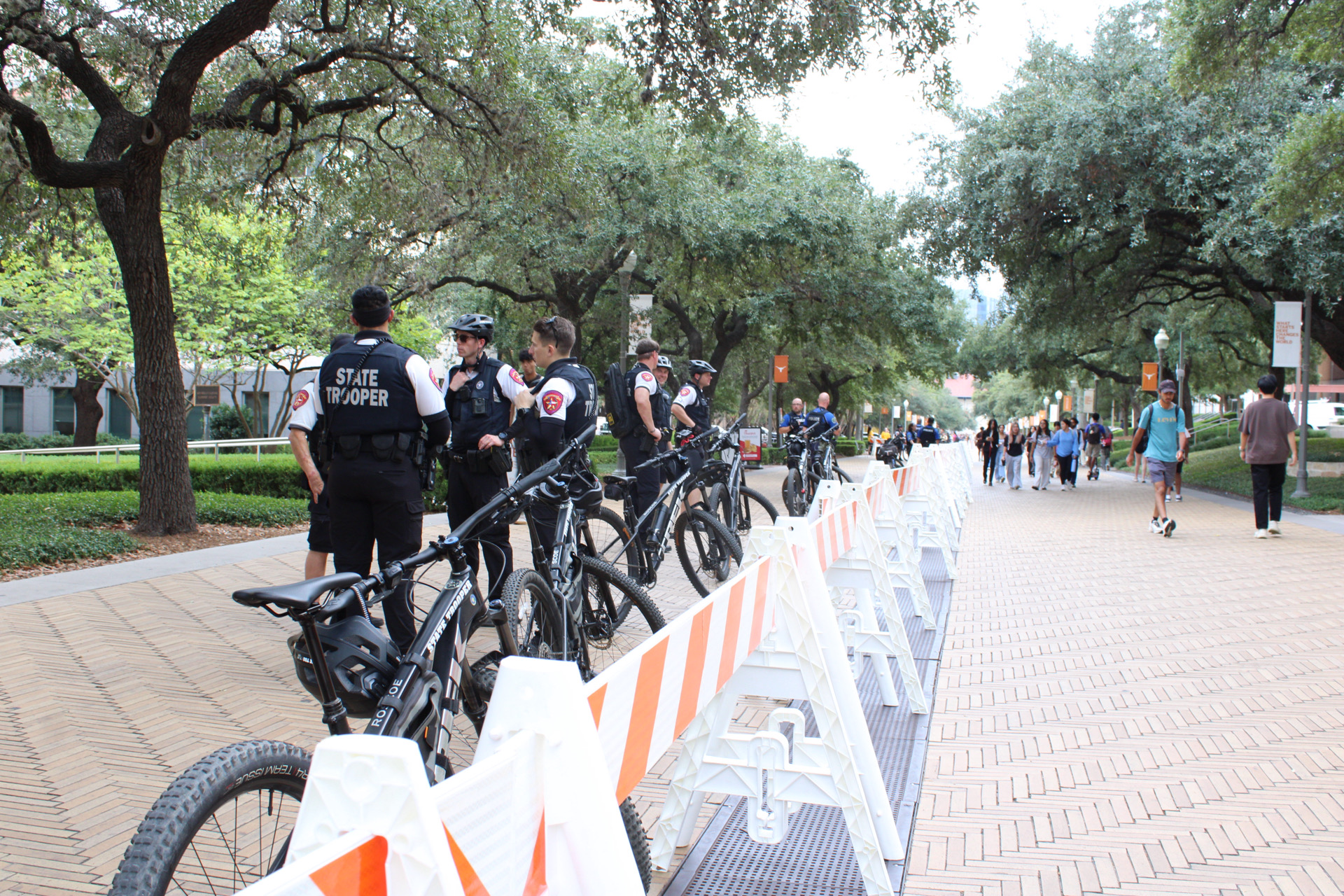
Austinites who expected overwhelming turnout and chaos on Wednesday for the appearance of the leftist political streamer Hasan Piker at the University of Texas at Austin were met with a lackluster showing: more law enforcement than protesters, and an auditorium only three-quarters full.
Despite efforts by both Democrats and Republicans to spread the message that events would go on as planned, students faced what Piker dubbed essentially a “soft cancelling.” The University Democrats received nearly 2,000 RSVPs to the event, but when the university failed to accommodate them with a larger venue, the group was forced to rescind tickets.
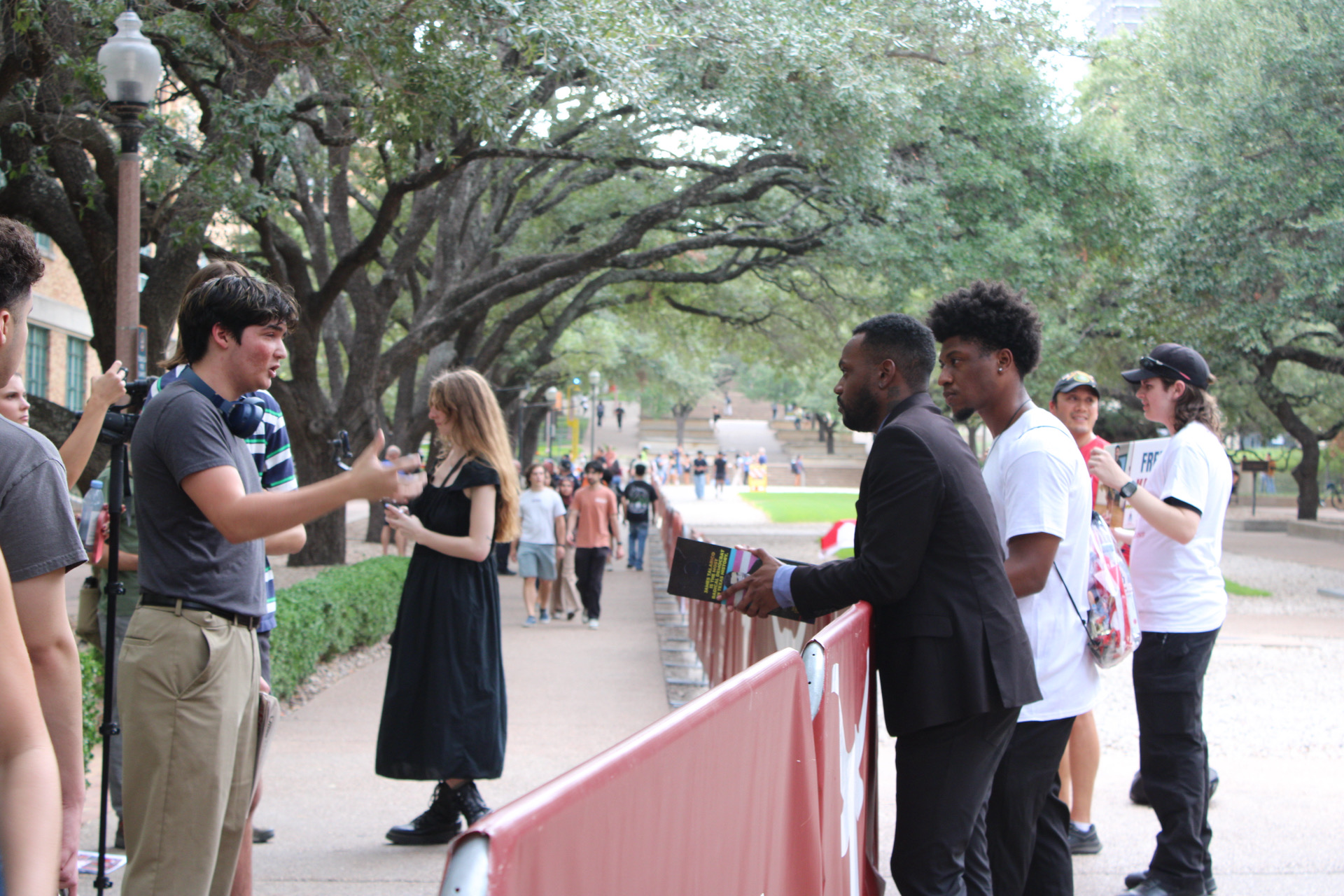
Students who missed out on seeing the commentator—who has built a massive online audience, with over 3 million followers on Twitch—told the Texas Observer that they thought their tickets or the event as a whole had been cancelled, and they were surprised to hear about the empty seats. The Austin Young Republicans also anticipated a contingent of around 150 protesters, but after state troopers surrounded their rally point, only about two dozen protesters arrived. The whole affair encapsulated how the Campus Protection Act, a bill passed in 2025 by the Republican state Legislature to restrict “expressive activities” on college campuses, and a political environment increasingly intolerant of free speech negatively impacts everyone—left and right—on public universities in Texas.
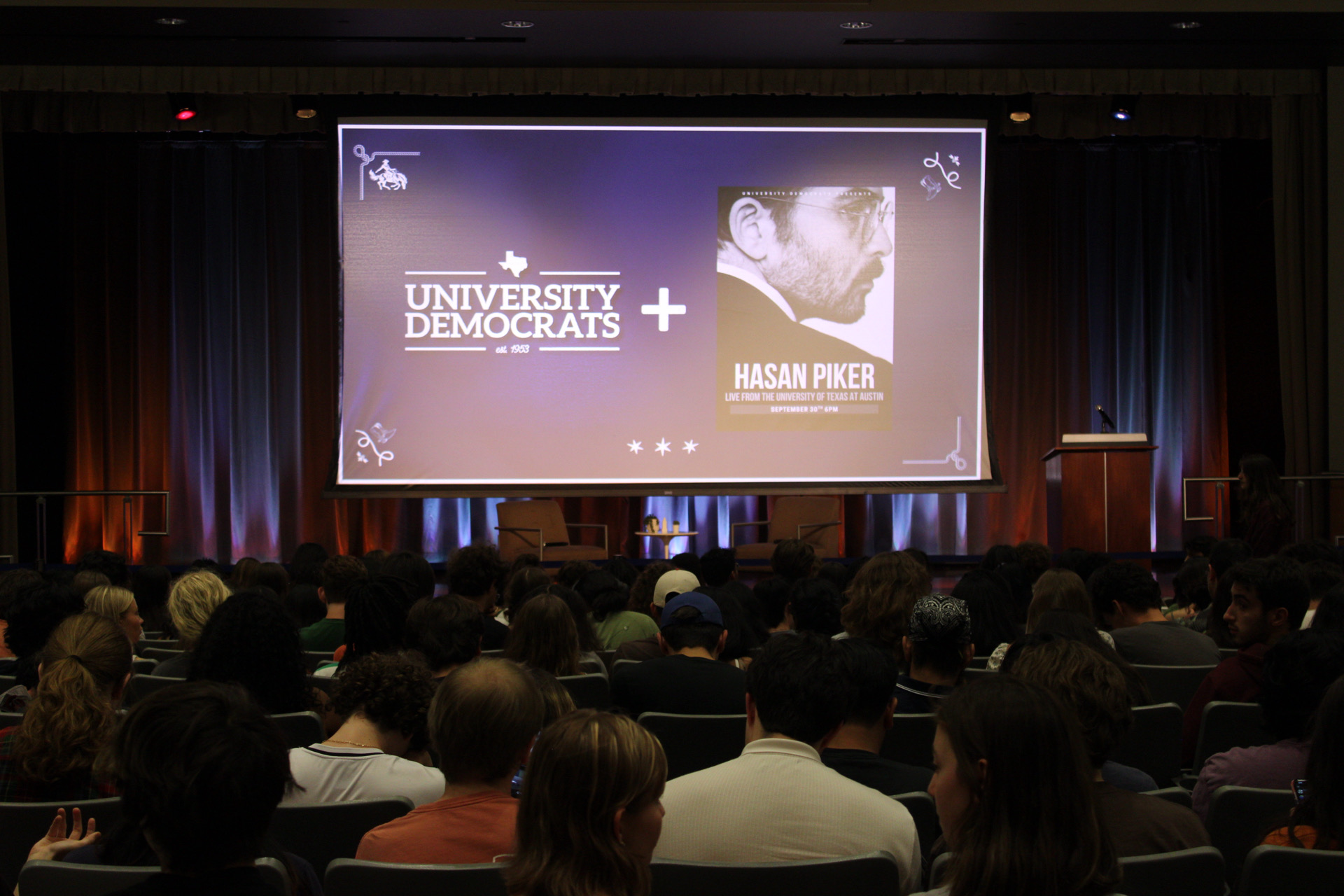
“I’ve done larger events than this. I’ve never had this much pushback. I’ve never had this much security concerns,” Piker said while streaming in the green room before taking the stage. Beside him sat Nick Escue, a member of the University Democrats who counts himself among Piker’s fans. The student said he was Piker’s driver to and from the event amid the high pressure environment and death threats against the streamer.
“It was super nerve-wracking. Anything could go wrong at any moment,” Escue said. “We were all stressing that if there was a slight incident, they would try to shut it all down.”
In the weeks leading up to the event, everyone from Governor Greg Abbott and Attorney General Ken Paxton to a number of local pro-Israel groups condemned the University Democrats for hosting the provocative streamer. Piker has been a prominent voice against Israel’s genocide in Gaza and faces rampant accusations of anti-Semitism, among a number of other controversies—although he characterizes himself as a staunch anti-Zionist who views Judaism as separate from Israel. Piker’s recent foray into campaigning with Democratic Socialists and other lefty candidates, such as Michigan Democratic Senate candidate Abdul El-Sayed, has swiftly transformed him into the bogeyman of the Republican Party—and of some centrist Democrats.
“He is the future of the left. He’s this collectivist Islamist,” Benjamin Schrader, President of the Austin Young Republicans, told the Observer. “He is not someone to be underestimated. Anyone who would is a fool because he is a serious threat.” (Piker, raised in Turkey, has said he is not religious.)
The day before the event, the university sent out an email to students outlining their free speech restrictions, many of which were established after the passing of the Campus Protection Act. The law passed in 2025, about a year after mass pro-Palestine protests swept across college campuses nationwide, including at UT. It limits free expression on public college campuses by transforming all common outdoor areas into “limited” public forums. That means individuals who are not students, faculty, or staff cannot conduct or even observe expressive activities on campus.
The email reiterated this principle, stating “Any participants who are not affiliated with the University will be asked to leave campus.”
The law also prohibited encampments, certain uses of amplified sound, and expressive activity during the last two weeks of school or between the hours of 10 p.m. to 8 a.m. A federal court placed an injunction on some of these clauses in October 2025 because of their broad interpretations that violate the First Amendment. However, the limited public forum still stands, as does another critical requirement: Student organizations must get advance permission from university administrators in order to host a guest speaker.
Escue said University Democrats were forced to jump through the bureaucratic hoops of a speaker approval process. After they finally confirmed the event with Piker, he said the Office of the Dean of Students continued trying “to poke holes in our event.” The burden of securing the event was placed on the University Democrats, who swiftly and successfully launched a fundraiser to cover the $25,000 in required security fees.
Escue pointed out that right-wingers regularly speak on campus, and he felt disappointed that most Democratic politicians didn’t support students amid the media onslaught.
When Piker finally took the stage Wednesday evening, he strayed from his usual stump speech to thank those in attendance and call out the university. “You can’t have an opinion that is outside of the permission structure, and the permission structure year over year seems to swing wildly in the rightward direction,” Piker said. “We have to fight back because, as I’ve seen in my travels all around the country since Trump came into office, our institutions have failed us—and even the national Democratic Party has failed us—but we have not failed one another.”
He went on to participate in a wide-ranging question and answer session with the president of the University Democrats, Adit Raha. They discussed support for the Democratic Socialists of America, turning Texas blue with James Talarico, and holding elected officials accountable.
Outside the auditorium, the Austin Young Republicans faced some issues of their own. Unlike others, Schrader said he didn’t want to cancel Piker’s event with the University Democrats. Instead, he called for both sides to exercise their freedom of speech. And Schrader said for the first time in its history, the Austin Young Republicans planned a protest. They formed a coalition with Reawaken USA, Texas College Republicans, and Young Americans for Liberty. Schrader said he started to learn about community organizing, even taking a thing or two from the left.
“Hey, they’re dang good at it,” Schrader said. “I was watching videos of how to run a protest from these communist groups, and I said, okay, I’m going to steal that. Let’s collectivize it!”
Aside from safety, one of Schrader’s biggest concerns was that his first ever rally would be put down by the university using the Campus Protection Act, so he was careful not to step on the toes of the administration. The group met with administrators and published a statement urging the university not to invoke the Campus Protection Act against its demonstration.
The Republicans arrived on campus Wednesday afternoon, where Schrader said they quickly encountered problems with the UT Police Department. “The campus did kick off our security and told them that if they escorted me and the Austin Young Republicans, they would be charged with criminal trespassing,” Schrader said. Lacking security, they carried on with their plan to meet at the George Washington statue in front of the UT tower and march down to the Student Activity Center.
When they arrived at the monument, it was surrounded by state troopers. They decided it best to avoid law enforcement altogether and went straight to the student center. Schrader said members of his coalition were already hesitant to attend for fear of being arrested. He believes the presence of law enforcement and the change of meeting point may have led to reduced turnout.
Despite the difficulties and the learning curve of putting on his first political protest, Schrader said it was a positive experience for the group. “People had a good time, and I’m grateful to God no one got arrested,” Schrader said. “We got to do more protests!”
The university has not responded to the Observer’s request for comment.
Both Republicans and Democrats told the Observer that they’d like to see the Campus Protection Act repealed because they believe it violates the First Amendment. There has been no movement on the issue since last year’s injunction, and the university Board of Regents—appointed by Abbott—has continued to expand its influence over nearly all aspects of university life.
Students said that the only way forward is to continue using and demanding their First Amendment rights to the fullest extent.
“Every imaginable roadblock and barrier was put up to stop this event from happening tonight,” Raha of the University Democrats said at the podium. “We still stand for universal health care, an economy that works for all, an end to the genocide in Gaza, our mission to abolish and prosecute ICE, and protecting one of America’s greatest values, the freedom of speech.”
The post Hasan Piker’s UT Appearance Put Campus Protection Act to the Test appeared first on The Texas Observer.


